THT-EX | Top LED Lighting Solutions Company 2023

THT-EX
Devoted to Design Explosion-proof LED Light

Share this Article:

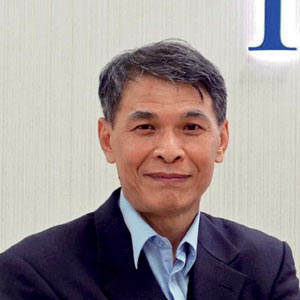
Peter Chen, Founder and Chairman, THT-EXPeter Chen, Founder and Chairman
At present, many organizations utilize conventional lighting like HPS and MH lamps. However, these light sources with large wattages can only provide the required lighting brightness after a period of time, as they need to be warmed up to reach the working temperature. They are also not energy-efficient and have a high failure rate.

The time and maintenance cost caused by lighting failure also greatly affects production efficiency and increases the cost of organizations.

That’s where THT-EX can help

Witnessing the great impact of lighting on safety and production and the demand for high-temperature lighting, THT-EX has launched LED lights that are small in size, lightweight, energy-saving, and environmentally friendly. Its LED light sources do not require preheating; the excellent heat dissipation design provides customers with safer and more stable lighting options.

THT-EX’s founder and chairman, Peter Chen, has almost three decades of experience in the design and manufacturing of waterproof connection systems for the chemical, marine, and aviation industries. The company utilizes his knowledge and expertise to put extra emphasis on reliability, robustness, and safety during product design. This is one of the reasons why it is the first company in the world to use direct AC-IN technology to design LED lighting fixtures for hazardous or high-temperature locations.

“The direct AC-IN technology not only solves the electrolytic capacitor failure problem in high heat environment but also provides the advantages for robust and reliable design on the Lighting fixture housing,” says Chen.

THT-EX's LED lights have a built-in IC and a bridge, which can directly convert the AC current of the mains into DC output to the LED and can directly light up the lamp without waiting. Unlike conventional lamps, THT-EX LED does not need additional space to accommodate the blaster. In addition, the environmentally friendly and energy-saving characteristics of LED lights can save manufacturers electricity costs. Besides, the cost of LED light installation and maintenance is low, and 90 percent of its light components can be recycled and reused, which make them environmentally friendly.


The direct AC-IN technology not only solves the electrolytic capacitor failure problem in high heat environment but also provides the advantages for robust and reliable design on the Lighting fixture housing

THT-EX puts great importance on the safety of customers’ life and property. The company designs products with explosion-proof capabilities. After the product design is done, they undergo the waterproof standard IP67 (IP68, IP69K), salt spray, impact, and strong wind resistance tests. They also meet all international explosion-proof standards, such as North American UL844 , European union ATEX, IECEx and Japan TIIS.

In addition to the unique AC-IN LED lighting solutions, THT-EX can also provide customized designs and services according to customer needs. The company has set up a CNC factory to produce key components to ensure quality, and its lead time is fast through automated production. All products are designed and manufactured in Taiwan instead of outsourcing. This plays a vital role in ensuring quality.
Deep Dive

Hazardous Area Engineering beyond Product Compliance

A hazardous-area lighting purchase can pass a certification review and still create trouble after installation. Heat, corrosive air, vibration, dust and continuous duty expose weaknesses that rarely appear in a catalog comparison. Buyers therefore face a narrower question than whether equipment carries the required marks. They must determine whether the supplier understands how certified products behave after years inside demanding plants. Long-term performance begins with application fit. A luminaire designed for a moderate indoor zone may not suit a coastal petrochemical site or a high-temperature process area. Housing design, thermal control, sealing and material selection all affect service life. Procurement teams should look beyond nominal ratings and ask how field conditions influence product design, validation and revision. A broad catalog offers little protection when the supplier cannot explain why one configuration belongs in a particular environment. Certification remains essential, but it should function as an entry threshold rather than the end of due diligence. Buyers working across regions need equipment aligned with the standards governing each site. They also need documentation that supports engineering review and later inspection. The deeper distinction lies in how certification knowledge connects to actual manufacturing discipline. Air-tightness checks, pressure testing, electrical safety verification and final functional review reduce variation between approved designs and shipped units. "THT-EX combines certified hazardous-area equipment with electrical connection technologies and power distribution under one engineering platform." Hazardous-area projects also become harder when lighting is treated as an isolated purchase. Power distribution, cable assemblies, connectors and visual signaling often meet at the same installation point. Separate suppliers can introduce interface gaps, mismatched specifications, installation rework and repeated approval cycles. A provider that understands the electrical path around the fixture can reduce coordination burden and help buyers resolve compatibility questions before site work begins. Visual communication adds another layer. Automated plants already produce more alarms than people can comfortably interpret. Warning devices must now convey machine status clearly to operators while remaining suitable for explosive atmospheres. Buyers should examine whether a supplier can connect certified visual signaling with broader industrial electrical systems without turning the project into a collection of unrelated devices. Clear status communication matters most during abnormal conditions, when delay or ambiguity can widen the consequence of a small fault. Manufacturing depth deserves equal scrutiny. Precision machining, standardized assembly, automated fastening and repeatable testing can improve consistency, but the value lies in how these controls are tied to verification. Field feedback should also return to engineering. Suppliers that study corrosion, temperature stress, humidity damage and installation failure can revise designs around observed conditions rather than assumptions. THT-EX approaches hazardous-area work as an integrated electrical engineering challenge rather than a lighting-only application. It combines certified hazardous-area equipment with electrical connection technologies and power distribution under one engineering platform. The company’s scope includes high-temperature explosion-protected lighting, explosion-protected UVC lighting, and Intelligent Visual Safety Systems designed for demanding industrial environments. International certifications like UL, IECEx, ATEX, and CML support applications across global markets, while in-house CNC machining, standardized production processes, automated fastening systems, and comprehensive testing strengthen manufacturing control. This integrated approach enables THT-EX to support customers seeking coordinated lighting and hazardous-area electrical solutions. ...Read more
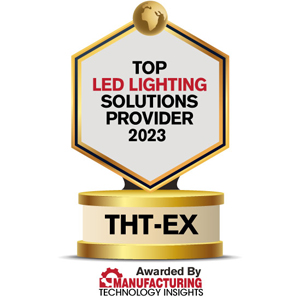
Top 10 LED Lighting Solutions Companies – 2023

Company
THT-EX

Management
Peter Chen, Founder and Chairman

Description
THT-EX has been devoting to design Explosion-proof LED Light for hazardous location applications for years. Its LED lighting products are manufactured in Taiwan with features of operatable at -65℃ low- temperature and high-temperature environments from 65℃ up to 120℃ as well as waterproof rating IP67 / IP68